
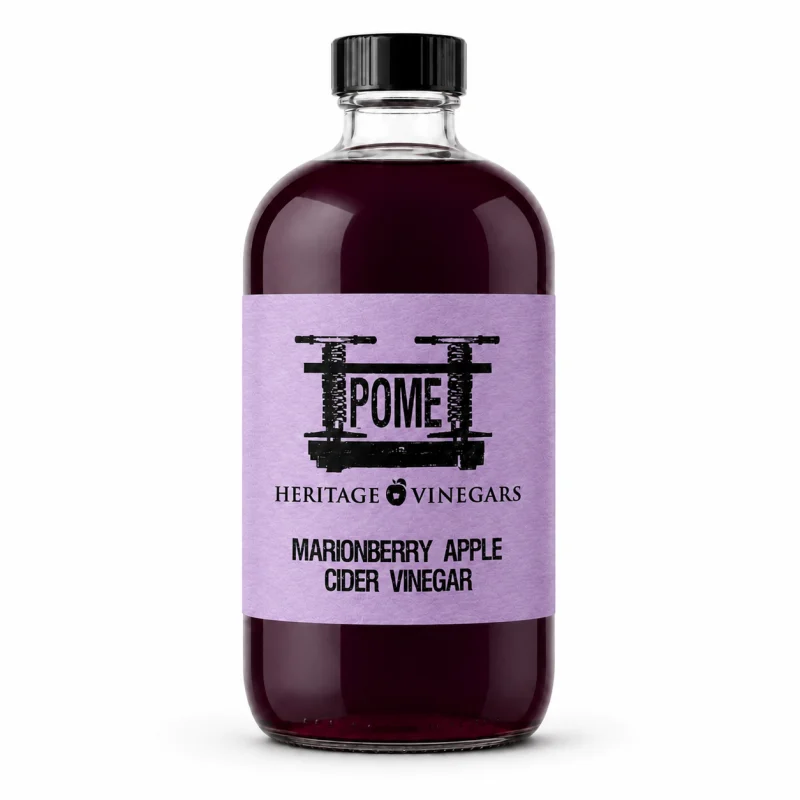
Oregon marionberries are one of the Pacific Northwest’s most distinctive crops. They are a blackberry hybrid developed at Oregon State University, named for Marion County, and grown almost entirely in the Willamette Valley. They are deeply flavoured, intensely coloured, and far more complex than the commodity blackberries in most grocery freezers.
This expression takes whole Oregon marionberries and macerates them in POME apple cider vinegar. The fruit steeps in the finished vinegar and gives up its colour and character to it. Nothing is sweetened, and no flavouring is added.
The character
It is noticeably different from the Bittersweet. It is darker, with a deep reddish purple cast that comes from the berries themselves rather than from anything added. The berry character is present but restrained. This is not a fruity vinegar in the usual sense. It is a vinegar carrying the fruit it was steeped with.
Because there is no added sweetness, it stays a vinegar rather than drifting toward a cordial. People who find the Bittersweet too sharp on its own often prefer this one for daily drinking.
Ingredients
Raw apple cider vinegar with the mother, marionberries. No added sugar, no juice concentrate, no flavouring. Acidity minimum 5 percent.
Suggested uses
- Vinaigrettes for bitter greens such as frisée, arugula and radicchio. The berry bridges the bitterness.
- Marinades for duck, lamb or pork.
- As a shrub base, for cocktails and for drinks without alcohol. Use equal parts vinegar, sugar and sparkling water.
- As a daily drinking vinegar. One tablespoon in 8 to 12 ounces of water. Always dilute.
Storage. Room temperature, out of direct sun. Shake before use to redistribute the mother.
Raw and unpasteurised, containing live cultures. Sediment and haze are natural. If you are pregnant, immunocompromised or managing a medical condition, talk to your healthcare provider before adding any vinegar to your routine.
Reviews
There are no reviews yet.